Beijing Confirms Talks for Tripartite Summit in Shenzhen
Chinese officials say negotiations are ongoing for a gathering with the U.S. and Russian presidents on the sidelines of the APEC summit.
By Oliver Bennett ·
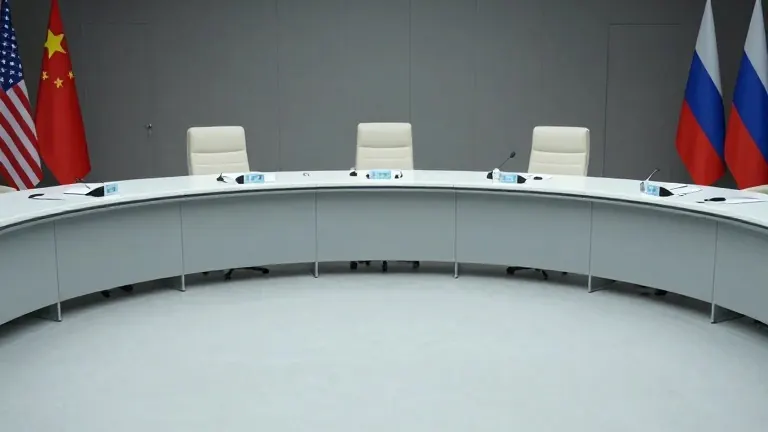
Beijing has acknowledged for the first time that it is negotiating a formal meeting with Washington and Moscow. The potential trilateral summit would mark a rare convergence of the three major powers, a development analysts say is driven more by diplomatic optics than by shared policy goals.
Mao Ning, a spokesperson for the Chinese foreign ministry, confirmed the discussions during a press briefing in Beijing. She stated that China is in communication with relevant parties regarding a gathering of the three heads of state. If the logistics hold, the meeting is scheduled to occur this month on the sidelines of the Asia-Pacific Economic Cooperation summit in Shenzhen.
The timing coincides with a fragile trade truce between the United States and China that expires in January. President Donald Trump is expected to travel to Shenzhen for his third meeting with President Xi Jinping this year. While the leaders maintain a working relationship, U.S. Trade Representative Jamieson Greer recently pressed Beijing to take concrete actions on agricultural purchases and rare earths. In response, China’s Xinhua news agency reported that the two sides had constructive exchanges but that China continued to voice concerns about Washington’s restrictive trade measures.
Experts question whether the three leaders will achieve substantive policy breakthroughs. Sun Yun, director of the China program at the Stimson Center, believes the meeting will likely proceed but noted that the format and content remain the key variables. She observed that China seeks the visual image of unity without incurring the diplomatic costs of deep negotiations. Danny Russel, a former senior State Department official, suggested that Russia has the most to gain from the gathering, viewing it as a diplomatic coup that would allow President Vladimir Putin to engage directly with his counterparts.
The agenda is expected to be tightly managed. Trump has expressed interest in discussing nuclear arms controls, while Putin has focused on the war in Ukraine, notably excluding Kyiv from the potential dialogue. Advisers have reportedly urged the U.S. president to avoid making Ukraine a central topic to prevent complicating the trade negotiations. Sun warned that Russia may attempt to nudge China and the U.S. closer to Moscow’s positions, requiring Beijing to manage what she described as Russian manipulation.
China has indicated it will not engage in detailed talks on arms control or the conflicts in Ukraine and Iran, limiting its comments to general statements that peace is important. Craig Singleton, a senior director at the Foundation for Defense of Democracies, characterized the event as a photo opportunity. He noted that while the spectacle may be historic, the diplomatic returns of such visual alignments are diminishing.
Beijing is hosting this year’s APEC summit, a grouping that includes 21 member economies. The Chinese government is focused on ensuring the event is not perceived as three great powers dividing the world. With the trade truce expiring in January, the outcome of these high-stakes conversations will be watched closely by markets and diplomats alike.